
By Rinki Pandey December 29, 2025
Merchant Processing Statement is one of the most neglected, but at the same time one of the most important skills for those business owners who accept card payments to have. Merchants receive bills full of figures, percentages, and weird terminologies every month and usually ignore or merely skim-read those parts. This negligence hinders businesses, resulting in significant losses in the form of unwarranted fees, which amount to thousands of dollars each year. Payment processors use complicated layouts and technical language, which makes it difficult for excessive fees to go unnoticed.
A merchant processing statement shows more than billing; it shows a financial map that reveals the exact amount you are paying to get credit and debit card transactions processed. Inside, there are also credit card processing fees, service charges, and adjustments that take away or add to your profit margins. If you do not know how to read a statement correctly, you are likely to pay your payment processor more than you should or continue to pay for a service that you do not need.
The purpose of this guide is to make it easier for sellers to interpret their merchant processing statement quickly and notice merchant fees without misunderstanding. It does not use technical terms but rather emphasizes practical explanations and real-life examples that make the review of your statement easy and efficient. No matter whether your business is a retail store, an online shop, or a service-based company, being able to analyze your processing statement gives you the power to cut down costs, get better rates, and safeguard your income.
Understanding the Purpose of a Merchant Processing Statement
A merchant processing statement is a comprehensive monthly report containing detailed information about the whole process of card payments by your payment processor- handling, approving, and charging. It documents the entire process of accepting card payments, recording, and finally charging every transaction, deduction, and adjustment.
This document is primarily aimed at the provision of transparency. However, in practice, the majority of statements are made purposely unclear. Processors apply fees under obscure names, mix charges, or employ such technical terms that they repel customers from making scrutiny.
A typical merchant processing statement consists of the following:
- Total sales volume processed.
- Number of transactions.
- Refunds and chargebacks.
- Interchange and assessment costs.
- Processor markup and service fees.
When you recognize its purpose, you cease to regard the statement as a mere formality and instead, employ it as a financial control instrument. A careful review makes it possible for you to easily identify and track the current rates of credit card processing fees, check if the contract conditions are being met, and dispute unjust pricing.
Merchants that constantly monitor their statements sometimes discover payment processor charges that were previously unnoticed due to the long time they had accumulated. This revelation turns your statement into not just a report but also a strong resource for cost management.
Also Read: How Dual Pricing Works and Why Many Merchants Are Switching
Breaking Down the Key Sections of a Merchant Processing Statement

No matter what the provider is, every merchant processing statement has a common structure, but the design may be different. If you are able to identify these fundamental sections, you will be able to navigate through the statement quickly and spot the problem areas.
Almost all statements have the following sections:
- Summary page.
- Transaction detail section.
- Charges section.
- Adjustments and miscellaneous fees.
The summary page displays the total sales, the total fees, and the net deposits. It is very useful, but at the same time, it conceals important details. The actual understanding comes from the breakdown of the transactions and the fees. The transaction detail section gives the card types (Visa, Mastercard, AmEx), the number of transactions, and the total volume. This is the place where you verify the accuracy of processing. The fees section indicates the actual credit card processing fees, such as interchange, assessments, and markup. In order to make it more difficult for one to compare, processors usually put them together.
If you know how these sections work together, you will be able to follow each dollar from the customer’s payment to your bank deposit. Here, unexpected deductions indicate either hidden merchant fees or compliance penalties. Also, adjustments refer to refunds, chargebacks, or reversals.
Identifying Interchange Fees in a Merchant Processing Statement
Interchange fees constitute, to a great extent, the major category of expenses in any merchant processing statement. They are the fees set by the card networks that are not subject to negotiations and are paid to the issuing banks. What depends on the interchange?
- Type of card
- Method of transaction
- Type of business (MCC code)
On your statement, interchange may show up as follows:
- Interchange expense
- IC fees
- Wholesale cost
Processors frequently bundle interchange with markup, which makes it difficult to distinguish between the costs that are actually legitimate and the ones that are just inflated by the payment processor charges. A transparent invoice should display interchange as a separate line item. If this is not the case, you might be on a tiered pricing model, which masks the actual costs and frequently inflates the credit card processing fees.
Take a close look at the interchange to make sure that the rates applied are consistent with your transaction profile. A sudden rise in the rates could be a sign of more keyed-in transactions or of payments being downgraded due to insufficient data.
Understanding Processor Markup in a Merchant Processing Statement
Processor markup is essentially the point where the providers get their profits from, and it is the most negotiable aspect of your merchant processing statement.
Markup can take the form of:
- Percentage fees
- Per-transaction fees
- Monthly service charges
These fees can be referred to as:
- Discount rate
- Processing fee
- Service fee
Markup is usually concealed behind other fees, so it is hard to spot the excessive hidden merchant fees. Check the markup against the industry averages. Small businesses using the interchange-plus pricing model typically pay only reasonable markups. If your markup is not clear, that is a warning sign.
High processor markup is very often caused by outdated contracts or tiered pricing plans. Go through this part, and you might be able to renegotiate or change the provider to cut down on payment processor charges that are unnecessary.
Spotting Tiered Pricing Traps in a Merchant Processing Statement
Tiered pricing is among the most confusing aspects of a merchant processing statement and a leading cause of overcharge. Transactions are classified as:
- Qualified
- Mid-qualified
- Non-qualified
Each category has its own charge, but processors seldom tell the reason for the downgrading of transactions. Most rewards cards belong to the higher tiers. Thus, the credit card processing fees are greatly increased. Tiered pricing creates a situation where it is nearly impossible to analyze the actual costs. You might be attracted to advertised rates, but in the end, you pay more because of non-qualified transactions. In case the interchange is not clearly marked apart from the markup in your statement, through tiered pricing, you are most likely paying hidden fees to the merchant. This situation allows us to drift towards interchange-plus pricing, which is transparent and in which the costs are well defined.
Reviewing Monthly and Annual Fees on a Merchant Processing Statement
Apart from transaction fees, your merchant processing statement also shows periodic charges that escalate over time. Recurring fees that are often seen include:
- Statements of monthly fees.
- Compliant PCI fees.
- Annual getting-hold-of the Member fees.
- Access to gateway fees.
Lots of dealers do not see these fees, as they are very small. However, if you put them together, they will still have a big impact on your profitability. There are some fees that might not apply to your business, but they still continue because of inactive services or outdated contracts. These fees are classic scenarios of hidden merchant service statement fees. The goals statement is against the original agreement. Any unexplained payment processor charges should be questioned right away. Cutting down on useless recurring fees is among the quickest ways to reduce overall processing costs.
Detecting PCI and Compliance Charges in a Merchant Processing Statement
As a matter of fact, PCI compliance fees are a regular occurrence, but not easily understood on a merchant processing statement.
The processors impose fees for:
- PCI compliance initiatives.
- Fines for non-compliance.
- Security tests.
Those fees may show up as either monthly or yearly fees. Not filling in PCI questionnaires may often lead to very high fines, at times undercover as “security fees.” Not every processor has PCI fees, and the costs can be very different. Overcharging for compliance usually indicates that there are hidden merchant fees within the signed agreements. Pay close attention to this part of the document to verify that fees are reasonable and that the compliance requirements are clearly understood.
Analyzing Chargebacks and Retrieval Fees in a Merchant Processing Statement
Chargebacks are indeed losses that come with a lot of processing hassle as well. They are shown on the merchant processing statement as a set of deductions and separate charges. Some of the common charges related to chargebacks are:
- Chargeback processing fees.
- Retrieval request fees.
- Representment fees.
Even in the case of winning the dispute, still charging fees may still be there. Large chargeback expenses inflate the total credit card processing costs. Keeping an eye on this area will enable you to spot fraudulent activities, upgrade transaction methods, and minimize your losses in the future.
Comparing Net Deposits to Gross Sales Using a Merchant Processing Statement
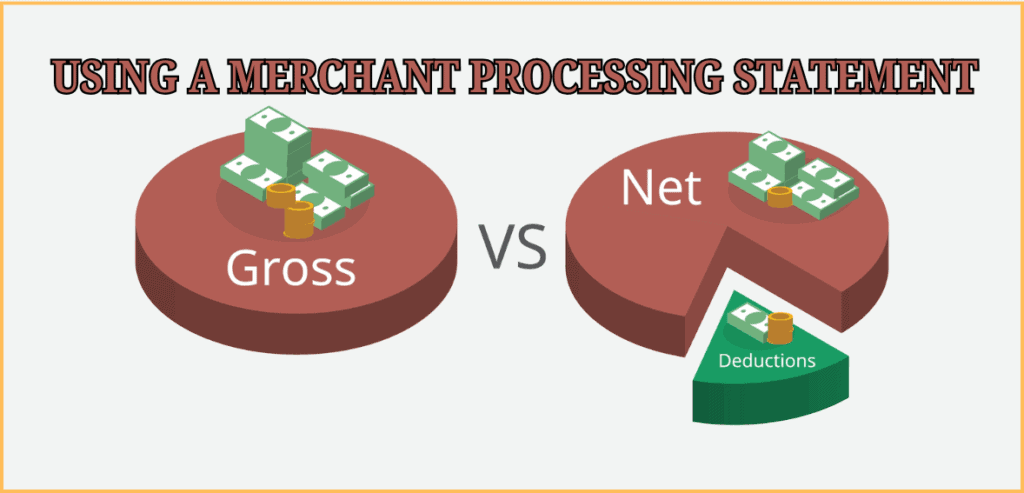
Reconciling gross sales with net deposits is one of the primary checks performed in every merchant processing statement, and it is probably the most important check. The following figures must be confirmed:
- Total processed volume.
- Total fees deducted.
- Net amount deposited.
Discrepancies of a large amount often mean that charges by the payment processor were overlooked, or there is a difference in timing. Consistent review also helps to detect unauthorized deductions, batch errors, or settlement delays. This step makes sure that your statement corresponds to the bank deposits and that no hidden merchant fees are silently cutting into the revenue.
Using a Merchant Processing Statement to Negotiate Better Rates
Your merchant processing statement is definitely the strongest weapon in your negotiation arsenal. Processors count on merchants to be confused about their bills. By pointing out:
- High markup.
- Tiered pricing penalties.
- Unnecessary recurring fees.
You can either negotiate lower rates or change the provider. A clear analysis presents you as a knowledgeable merchant, which in turn increases your bargaining power during the rate negotiations. A considerable number of providers will cut credit card processing fees if they have a well-informed client. Periodic evaluations will make sure that your costs are still competitive even as your company expands.
Conclusion
Never ignore or accept a merchant processing statement without question. It gives you very important information on where your money goes and how effective your payment system is. A document that might appear to be routine could be a powerful financial tool that helps in revealing excessive fees, pricing inconsistencies, and cutting unnecessary expenses.
You will achieve financial clarity that is greater and control over your payment costs in the long run if you properly comprehend every section, pinpoint the processor markup, and uncover the merchant fees that are hidden. Going through statements regularly will stop overcharging, draw attention to the rising credit card processing fees, and make the payment processor charges all the more aligned with the contract terms. Companies can tackle this problem when it is still minor, as this proactive approach allows them to do so before small fees accumulate into significant losses.
In the current cut-throat market, reading your merchant processing statement is not an option – it is a must for the growth of your business through sustainability. Merchants that constantly review and comprehend their statements have already gained the ability to negotiate better rates, select the pricing models that are the most transparent, and maintain healthy profit margins. It is the case that being able to manage your merchant processing statement ultimately equips you to take smarter financial steps and run your business with assurance and clarity.
FAQs
What exactly is a merchant processing statement?
An overview of the card transactions, the charges taken, and the net amount transferred to your bank account is the monthly report provided by your payment processing company in the form of a merchant processing statement.
Why are the credit card processing fees different every month?
Credit card processing fees change every month due to a variety of reasons, which consist of the kinds of cards used, the ways of transaction, returns, and chargebacks, plus movement in the volume of processing.
What steps should I take to reveal the hidden fees that have been accounted for in my bill?
You can spot hidden merchant fees through the processor markup, monthly service fees, PCI charges, and tiered pricing categories, as these sections often contain them.
What other costs are associated with payment processors apart from transaction fees?
Payment processors might charge monthly account fees, PCI compliance fees, gateway fees, chargeback fees, and annual maintenance costs as their charges.
How frequently is it necessary to review the merchant processing statement?
You must review your merchant processing statement each month to be able to detect any price rise early and to keep unnecessary charges from affecting your profits.